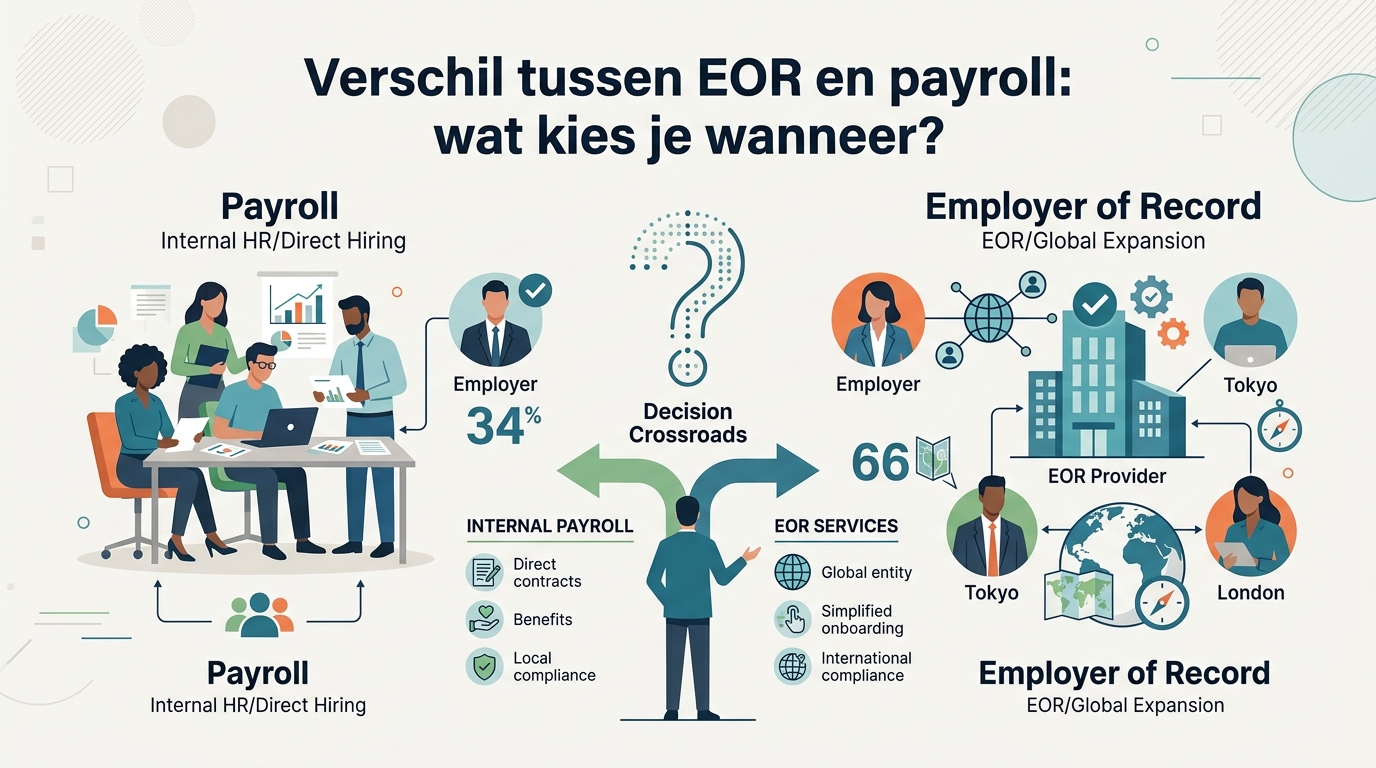
Het verschil tussen een Employer of Record (EOR) en payroll zit in het juridisch werkgeverschap. Een EOR wordt de juridische werkgever van je medewerker — vaak in een land waar je geen eigen entiteit hebt — en regelt het arbeidscontract, de salarisadministratie, de belastingafdracht en de lokale compliance. Payroll als loonverwerking betekent dat je alleen de administratieve salarisverwerking uitbesteedt en zelf werkgever blijft. Let op: in Nederland heeft het woord "payroll" twee betekenissen, want een payrollbedrijf neemt het juridisch werkgeverschap juist wél over.
| Aspect | Employer of Record (EOR) | Payroll (loonverwerking) |
|---|---|---|
| Juridisch werkgever | De EOR | Jij blijft werkgever |
| Internationale dekking | Land zonder eigen entiteit | Land waar je al een entiteit hebt |
| Verantwoordelijkheid | Contract, loon, belasting, compliance | Alleen salarisadministratie |
Verschil tussen EOR en payroll in het kort
De kortste samenvatting: bij een EOR verschuift het werkgeverschap naar een externe partij, bij payroll als loonverwerking blijft het bij jou. Een EOR neemt de volledige werkgeversrol over zodat je iemand in dienst kunt nemen in een land waar je geen juridische entiteit hebt. Bij kale loonverwerking koop je enkel een administratieve dienst in — de loonstroken, de loonaangifte en de afdracht van premies — terwijl jij de juridische werkgever en risicodrager blijft.
Inzicht
De grootste verwarring zit niet in EOR, maar in het woord "payroll". In de internationale context betekent payroll vrijwel altijd alleen salarisverwerking. In de Nederlandse context verwijst "payroll" of "payrolling" naar een payrollbedrijf dat juist wél het juridisch werkgeverschap overneemt. Dezelfde term, twee tegengestelde betekenissen.
We ontwarren beide betekenissen verderop expliciet, vergelijken de modellen in een complete tabel en sluiten af met een beslisrichtlijn. Wil je daarna concrete aanbieders naast elkaar zetten, dan kun je EOR-oplossingen vergelijken of kijken naar payroll-software en -leveranciers.
Wat is een Employer of Record (EOR)?
Een Employer of Record is een externe organisatie die de juridische werkgever wordt van een medewerker namens jouw bedrijf. Jij bepaalt wat de medewerker doet, hoeveel die verdient en hoe het dagelijkse werk eruitziet; de EOR draagt de formele werkgeversverantwoordelijkheid en zorgt dat alles juridisch en fiscaal klopt in het betreffende land.
Wat doet een EOR precies
Een EOR neemt de volledige administratieve en juridische werkgeversrol op zich. In Nederland wordt de EOR juridisch werkgever en is daarmee verantwoordelijk voor de arbeidsovereenkomsten, de salarisadministratie, de belastingafdracht en de naleving van lokale wetgeving [1]. Concreet regelt een EOR doorgaans:
- Het opstellen en beheren van een lokaal conform arbeidscontract
- De salarisverwerking, loonaangifte en afdracht van sociale premies
- Naleving van lokale arbeidswetgeving en privacyregels (AVG)
- Secundaire arbeidsvoorwaarden (benefits) zoals pensioen en verlof
- Beëindiging van het dienstverband volgens lokaal ontslagrecht
Een EOR met eigen entiteiten biedt ondersteuning bij inhuren in meer dan 150 landen [1]. Daarmee kun je internationaal opschalen zonder in elk land zelf een onderneming op te zetten.
Wanneer kies je voor een EOR
Een EOR past wanneer je iemand wilt aannemen in een land waar je geen juridische entiteit hebt en je dat snel en compliant wilt doen. Het alternatief — zelf een lokale entiteit oprichten — kost veel tijd en geld. Met een EOR kun je nieuw talent binnen enkele dagen onboarden [1]; afhankelijk van de provider lukt dat vaak binnen 1 tot 14 dagen [2]. Het opzetten van een eigen entiteit in Nederland kan daarentegen maanden duren [1] en loopt soms op tot zes maanden [2].
Tip
Gebruik een EOR als een tijdelijke of permanente brug. Test eerst een nieuwe markt met één of twee medewerkers via een EOR; groeit het team door, dan kun je later alsnog een eigen entiteit oprichten en de medewerkers overzetten.
Wat is payroll (loonverwerking)?
Payroll betekent letterlijk de verwerking van de loonadministratie: het berekenen van brutolonen en nettolonen, het opstellen van loonstroken, de loonaangifte en het afdragen van belastingen en sociale premies. Bij payroll in deze betekenis koop je een administratieve dienst in en blijf je zelf de juridische werkgever. Maar in Nederland heeft het woord een tweede, afwijkende betekenis — en dat is precies waar de verwarring ontstaat.
Twee betekenissen van 'payroll' in Nederland
Het is belangrijk om twee lezingen uit elkaar te halen, omdat ze leiden tot een tegenovergesteld antwoord op de vraag "wie is de werkgever?".
- Payroll als loonverwerking (salarisadministratie). Je besteedt de administratieve verwerking van het loon uit aan een dienstverlener of softwarepakket. Jij blijft de juridische werkgever, draagt de werkgeversrisico's en houdt het arbeidscontract op je eigen naam.
- Payrolling via een payrollbedrijf. Je werft, selecteert en stuurt de medewerker zelf aan, maar het payrollbedrijf neemt het juridisch werkgeverschap over. Het payrollbedrijf wordt formeel de werkgever en draagt de bijbehorende risico's.
Let op
Verwar deze twee niet. Wie "payroll = alleen loonverwerking" leest terwijl de andere partij "payrolling via een payrollbedrijf" bedoelt, trekt verkeerde conclusies over aansprakelijkheid en werkgeverschap. Vraag bij elke offerte expliciet: word ik zelf de juridische werkgever, of niet?
Payrolling en de wet: Waadi, WAB en juridisch werkgeverschap
Payrolling in de Nederlandse zin valt onder het arbeidsrecht voor het ter beschikking stellen van arbeidskrachten. De Wet allocatie arbeidskrachten door intermediairs (Waadi) en de Wet arbeidsmarkt in balans (WAB) bepalen onder meer dat payrollkrachten recht hebben op gelijkwaardige arbeidsvoorwaarden als vergelijkbare eigen werknemers. Daarnaast geldt een registratieplicht: alle intermediairs die in Nederland personeel uitlenen — zoals payroll- en uitzendbedrijven — moeten geregistreerd staan in het Handelsregister van de KVK [3].
Wil je weten of een partij die personeel uitleent correct geregistreerd staat? De Waadi-check van de overheid laat dat zien.
Door aangescherpte wetgeving rond het uitlenen van arbeid is een toelatingsstelsel in ontwikkeling, waarbij uitleners aan extra eisen moeten voldoen voordat ze personeel ter beschikking mogen stellen. Controleer daarom altijd of een payroll- of uitzendpartij aan de geldende registratie- en toelatingseisen voldoet.
EOR vs payroll: de verschillen op een rij
De onderstaande tabel zet de internationale EOR naast payroll als loonverwerking — de twee modellen die in de meeste vergelijkingen door elkaar lopen.
| Kenmerk | Employer of Record (EOR) | Payroll (loonverwerking) |
|---|---|---|
| Juridisch werkgever | De EOR wordt werkgever | Jij blijft werkgever |
| Aansprakelijkheid | Bij de EOR | Bij jou |
| Compliance | EOR borgt lokale wetgeving | Jij blijft verantwoordelijk |
| Internationale dekking | Inhuren zonder eigen entiteit | Eigen entiteit vereist |
| Snelheid van onboarden | Vaak binnen 1–14 dagen [2] | Afhankelijk van bestaande entiteit |
| Kostenmodel | Bedrag of percentage per medewerker per maand | Tarief voor administratieve verwerking |
| Wanneer kiezen | Geen entiteit in het land | Wel een entiteit, alleen administratie uitbesteden |
Juridisch werkgeverschap en aansprakelijkheid
Dit is de kern. Bij een EOR ligt het werkgeverschap — en daarmee de juridische aansprakelijkheid — bij de EOR. Bij payroll als loonverwerking houd je het werkgeverschap zelf en draag je de werkgeversrisico's. Bij payrolling via een Nederlands payrollbedrijf verschuift het werkgeverschap juist wél naar dat bedrijf.
Compliance en lokale arbeidswetgeving
Een EOR borgt de lokale compliance: arbeidsrecht, loonaangifte, sociale premies en privacyregels (AVG). Dat is waardevol in landen waar je de regels niet kent. Lokale verplichtingen kunnen aanzienlijk zijn: in Nederland geldt bijvoorbeeld een wettelijk minimum van 20 betaalde vakantiedagen per jaar [2], en de totale werkgeverslasten kunnen oplopen tot 33,29%, exclusief aanvullende benefits [2]. Bij kale loonverwerking blijf je zelf eindverantwoordelijk voor die naleving.
Internationale dekking (entiteit nodig of niet)
Dit bepaalt vaak je keuze. Een EOR met eigen entiteiten kan inhuren in meer dan 150 landen [1], zonder dat jij daar een onderneming opzet. Payroll als loonverwerking veronderstelt dat je al een entiteit in het land hebt; zonder entiteit is loonverwerking alleen geen optie om iemand lokaal in dienst te nemen.
Snelheid van onboarden
Met een EOR onboard je vaak binnen enkele dagen [1], in de praktijk binnen 1 tot 14 dagen afhankelijk van de provider [2]. Zelf een entiteit opzetten kost in Nederland maanden [1], soms tot zes maanden [2]. Dat verschil in doorlooptijd is doorslaggevend als je snel talent wilt vastleggen.
Kosten en prijsmodel
Een EOR rekent doorgaans een bedrag per medewerker per maand of een percentage van het salaris, bovenop de loonkosten. Dat oogt duurder dan kale loonverwerking, maar is meestal goedkoper en sneller dan zelf een entiteit oprichten.
Cijfer
Volgens Deel bedragen de eenmalige opstartkosten van een lokale entiteit in Nederland circa €36.407, met circa €48.081 aan jaarlijks terugkerende kosten [1]. Dit is een opgave van een leverancier (Deel) en niet onafhankelijk geverifieerd; gebruik het als indicatie, niet als vaststaand bedrag.
EOR, payroll, payrolling en uitzenden: hoe verhouden ze zich?
Vier termen lopen vaak door elkaar. Dit overzicht plaatst ze naast elkaar zodat je ze uit elkaar houdt.
| Model | Wie is werkgever? | Wie werft en stuurt aan? | Typisch bereik |
|---|---|---|---|
| EOR | De EOR | Jij | Land zonder eigen entiteit |
| Payroll (loonverwerking) | Jij | Jij | Land met eigen entiteit |
| Payrolling (NL payrollbedrijf) | Het payrollbedrijf | Jij | Doorgaans binnen één land |
| Uitzenden | Het uitzendbureau | Het uitzendbureau (werft mee) | Doorgaans binnen één land |
Het verschil tussen payrolling en uitzenden zit vooral in de werving: bij payrolling werf en selecteer je zelf en draagt het payrollbedrijf het werkgeverschap, terwijl een uitzendbureau zelf werft, selecteert én de werkgever is. Beide vallen onder dezelfde registratieplicht in het KVK-Handelsregister [3].
Korte afbakening: EOR vs PEO
In internationale zoekresultaten duikt naast de EOR ook de PEO (Professional Employer Organization) op. Het onderscheid is praktisch:
- EOR — wordt zelf de juridische werkgever, zodat je kunt inhuren zonder eigen entiteit in dat land.
- PEO — werkt via co-employment: je hebt nog steeds een eigen entiteit nodig en deelt het werkgeverschap met de PEO.
Heb je geen lokale entiteit, dan past een EOR. Heb je die wel en wil je HR- en payrolltaken delen, dan kan een PEO passen.
Wanneer kies je EOR en wanneer payroll?
Gebruik deze beslisrichtlijn als snelle keuzehulp.
Kies een EOR als:
- Je iemand in dienst wilt nemen in een land waar je geen entiteit hebt
- Je snel en compliant wilt opschalen zonder zelf een onderneming op te zetten
- Je het juridisch werkgeverschap en de lokale compliance wilt uitbesteden
- Je een nieuwe markt wilt testen met een klein team
Kies payroll (loonverwerking) als:
- Je al een entiteit hebt in het land waar de medewerker werkt
- Je alleen de salarisverwerking en loonaangifte wilt uitbesteden
- Je zelf de juridische werkgever wilt blijven
Kies payrolling via een Nederlands payrollbedrijf als:
- Je personeel in Nederland zelf werft en aanstuurt
- Je het juridisch werkgeverschap en de werkgeversrisico's wilt overdragen
Tip
Twijfel je tussen modellen voor de Nederlandse markt, leg de modellen dan naast je eigen situatie: heb je hier al een entiteit, en wil je werkgever blijven of niet? Die twee vragen bepalen meestal direct welk model past.
Hoe kies je de juiste EOR- of payrollpartner?
Heb je het model gekozen, dan volgt de keuze van een leverancier. Let bij de selectie op:
- Dekking en entiteiten. Heeft een EOR eigen entiteiten in de landen die je nodig hebt, of werkt het via partners? Eigen entiteiten geven doorgaans meer grip op compliance.
- Compliance en registratie. Controleer voor Nederlandse partijen de KVK-registratie en de geldende toelatingseisen voor uitleners [3].
- Prijsmodel. Vergelijk per medewerker per maand versus een percentage van het salaris, en let op verborgen kosten.
- Onboardingssnelheid. Vraag naar realistische doorlooptijden per land.
- Integratie met je HR-stack. Sluit de oplossing aan op je bestaande systemen? Begrijpen wat een HRIS is helpt om payroll- en EOR-data goed te laten aansluiten op je kernsysteem.
Wil je niet zelf alle aanbieders doorploegen, dan kun je een gratis intake voor een persoonlijke shortlist gebruiken, zodat je een neutrale vergelijking krijgt op basis van je eigen situatie.
Veelgestelde vragen over het verschil tussen EOR en payroll
Wat is het verschil tussen EOR en payroll?
Het verschil zit in het juridisch werkgeverschap. Bij een EOR wordt een externe partij de juridische werkgever en regelt die het contract, de salarisadministratie, de belastingafdracht en lokale compliance, ook in landen zonder eigen entiteit. Bij payroll als loonverwerking besteed je alleen de salarisverwerking uit en blijf je zelf werkgever. In Nederland neemt een payrollbedrijf het werkgeverschap juist wél over.
Is een EOR hetzelfde als een payrollbedrijf?
Nee. Een payrollbedrijf neemt in Nederland het juridisch werkgeverschap over voor personeel dat je zelf werft en aanstuurt, meestal binnen Nederland. Een EOR doet dat ook, maar specifiek om mensen in dienst te nemen in landen waar je geen entiteit hebt, met volledige lokale compliance. Een EOR met eigen entiteiten kan in meer dan 150 landen inhuren [1]; een payrollbedrijf opereert doorgaans binnen één land.
Wanneer kies je voor een EOR en wanneer voor payroll?
Kies een EOR als je iemand in dienst wilt nemen in een land zonder eigen entiteit en snel en compliant wilt opschalen. Kies payroll (loonverwerking) als je al een entiteit in dat land hebt en alleen de salarisverwerking en loonaangifte wilt uitbesteden terwijl je zelf werkgever blijft. Twijfel je over de NL-markt, dan helpt een neutrale vergelijking je verder.
Blijf ik werkgever bij payroll?
Dat hangt af van wat je met payroll bedoelt. Bij payroll als loonverwerking blijf je zelf de juridische werkgever en draag je de werkgeversrisico's. Bij payrolling via een payrollbedrijf in Nederland word je dat niet: het payrollbedrijf wordt de juridische werkgever en neemt de risico's over, terwijl jij werft, selecteert en aanstuurt.
Is een EOR duurder dan payroll?
Een EOR rekent doorgaans een bedrag per medewerker per maand of een percentage van het salaris, bovenop de loonkosten, omdat het de volledige werkgeversverantwoordelijkheid overneemt. Dat lijkt duurder dan kale loonverwerking, maar is vrijwel altijd goedkoper en sneller dan zelf een lokale entiteit opzetten, wat in Nederland maanden duurt [1].
Wat is het verschil tussen een EOR en een PEO?
Een EOR wordt zelf de juridische werkgever, zodat je kunt inhuren zonder eigen entiteit in dat land. Een PEO (Professional Employer Organization) werkt via co-employment: je hebt nog steeds een eigen entiteit nodig en deelt het werkgeverschap met de PEO. Heb je geen lokale entiteit, dan past een EOR; heb je die wel en wil je HR- en payrolltaken delen, dan kan een PEO passen.
Volgende stappen
- Bepaal eerst je situatie: heb je al een entiteit in het betreffende land, en wil je zelf werkgever blijven? Dat bepaalt direct of een EOR, payroll of payrolling past.
- Stel je eisen op rond dekking, compliance, prijsmodel en onboardingssnelheid, en controleer voor NL-partijen de KVK-registratie en toelatingseisen [3].
- Zet aanbieders naast elkaar via het overzicht om EOR-oplossingen te vergelijken of payroll-software en -leveranciers te bekijken.
- Check de aansluiting op je kernsysteem door te kijken naar wat een HRIS is en hoe payroll- en EOR-data daarin landen.
- Wil je een neutrale, op maat gemaakte selectie? Vraag een gratis intake voor een persoonlijke shortlist aan.
Bronnen
- Hoe neem je personeel aan met een Employer of Record in Nederland? — Deel
- Employer of Record (EOR) in the Netherlands: A Complete Guide — Rippling
- Waadi-registratie en -check — Ondernemersplein, Overheid.nl
- Wat is het verschil tussen payroll en employer of record? — Kweekers
- Employer of Record — Wikipedia